

Strategy in an Age of Permanent Disruption:

From Responding to Crises to Designing for Adaptability
In a recent post, Navigating the Middle East Conflict: Strategic Insights for Businesses, we explored how geopolitical instability is no longer an isolated or temporary disruption, but a structural feature of the global business environment. The article examined practical steps leadership teams must take—from supply‑chain diversification and legal preparedness to geopolitical intelligence and employee safety—to remain resilient amid escalating uncertainty.
That discussion, however, raises a more fundamental question—one that goes beyond any single crisis:
If wars, technological disruption, and geopolitical shocks are now persistent rather than episodic, is the way we design and govern business strategy itself still fit for purpose?
The Middle East conflict is not an exception. It is a clear signal of a broader reality: volatility is now the baseline. At the same time, AI is accelerating change at a pace that is compressing competitive advantages and rendering long‑term assumptions obsolete far sooner than most organisations expect.
In this environment, strategy cannot simply be adjusted more often. It must be re‑interpreted.
This article builds on the earlier discussion by stepping back from the “what should we do now?” question and addressing a deeper, more enduring challenge:
How should CxOs design strategy so that their organisations can sense, adapt, and recalibrate continuously—without losing strategic direction or organisational coherence?
To answer this, we revisit Gartner’s Three Horizons model and propose a shift in mindset—from strategy as a fixed plan to strategy as a continuous control system.

Gartner’s Three Horizons Still Matter—but They Are No Longer Sufficient
Gartner’s strategic planning model remains a powerful foundation. It distinguishes between:
Long‑term strategy (3–5 years): defining what success looks like
Midterm strategic plans (12–24 months): translating strategy into priorities and initiatives
Short‑term operational plans (6–12 months): executing projects and delivering outcomes
However, the model was conceived in an era where change was episodic, not constant. Today, CxOs are navigating an environment where:
Supply chains are re‑routed permanently, not temporarily
AI lowers cost and raises productivity non‑linearly
New competitors emerge without legacy constraints
Regulatory and political risk are no longer edge cases
Under these conditions, strategy cannot remain a static cascade. It must become something more dynamic.
From Strategy as a Plan to Strategy as a Control System
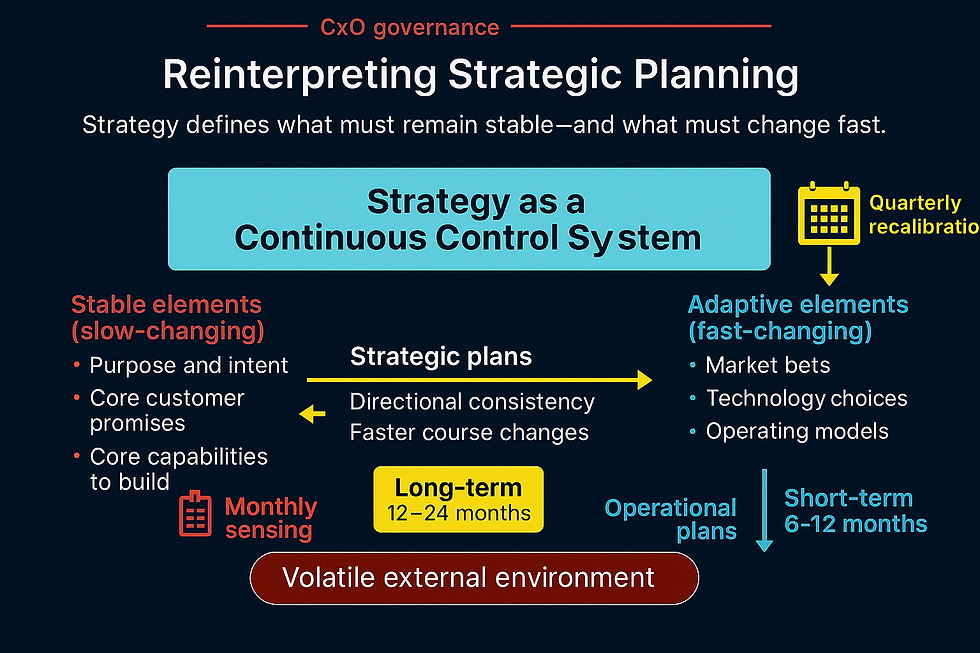
The most effective leadership teams are shifting their mindset from strategy as a document to strategy as a continuous control system.
In this model, strategy answers two questions simultaneously:
What must remain stable, no matter how turbulent the environment becomes?
What must be able to change quickly, without destabilizing the organization?
This distinction is critical.
What Stays Stable: The Strategic Anchors
Long‑term strategy is no longer about predicting markets five years out. Instead, it defines the anchors that guide decision‑making under uncertainty:
Purpose and strategic intent
Core customer promises
Core capabilities the organization must build (for example, data, AI fluency, or ecosystem partnerships)
These elements change slowly by design. They provide continuity and coherence, even as tactics shift.
For CxOs, this reframes the 3–5 year horizon from planning in detail to setting non‑negotiables.
What Changes Fast: The Adaptive Edge
If anchors stabilize the organization, adaptability gives it speed.
Fast‑changing elements include:
Market bets
Technology choices
Operating models
Capital allocation priorities
These are no longer decided once a year and “protected” from change. They are expected to evolve as conditions shift.
The danger today is not changing strategy too often—it is changing too slowly while believing you are being disciplined.
The Midterm Horizon Becomes the Control Layer
In this reinterpretation, the 12–24 month horizon is where strategy truly lives.
This is where:
Directional consistency is maintained
Course corrections are made decisively
Learning from execution is reflected back into priorities
Rather than locking in roadmaps, CxOs should treat strategic plans as rolling commitments, regularly tested against reality.
Strategy is no longer reviewed annually. It is continuously governed.
The New Role of the CxO: Sensemaker, Not Just Planner
This shift demands a new governance cadence at the top of the organization.
Monthly sensing
Each month, the C‑suite reviews signals—not slides:
External shocks and weak signals (geopolitics, regulation, competitors)
AI‑driven productivity and cost shifts
Talent and execution constraints surfacing from operations
The objective is not decision‑making, but early detection.
Quarterly recalibration
Each quarter, leaders deliberately ask:
Which bets still make sense?
What needs to be accelerated, paused, or stopped?
Where should capital and leadership attention move next?
Crucially, this recalibration does not reopen purpose or vision. It adjusts strategy without destabilizing identity.
As one simple rule of thumb:
We don’t change strategy every month—but we sense every month, and we recalibrate every quarter.
Why This Matters More in the Age of AI
AI magnifies both opportunity and risk. Productivity gains are uneven, adoption curves are unpredictable, and competitive advantage is increasingly temporary.
An organization that treats AI strategy as a fixed, multi‑year roadmap will almost certainly fall behind. One that embeds AI into its sensing, learning, and recalibration loops stands a chance of staying ahead.
The Bottom Line for CxOs
Adaptability is not the opposite of strategy. Adaptability is the condition that allows strategy to survive.
In an age of permanent disruption, the winning organizations will not be those with the most detailed long‑term plans, but those with:
Clear strategic anchors
Fast feedback loops
Disciplined governance
And the courage to adjust without losing direction
The question for today’s CxO is no longer “What is our strategy? ”It is:
“How quickly can our strategy learn?”
What This Means for SMEs
Small and medium‑sized enterprises may not have formal strategy teams, annual offsites, or multi‑year planning cycles—but they are often closer to volatility than large organizations. Cash flow sensitivity, talent constraints, AI disruption, and geopolitical spill‑overs tend to hit SMEs first and hardest.
The idea of Strategy as a Continuous Control System is therefore not just relevant to SMEs—it may be even more critical.
Here’s how SMEs can apply this without over‑engineering strategy.
1. Define a Small Set of Non‑Negotiables
SMEs should be clear on a few elements that remain stable, even when everything else changes:
Why the business exists
The kind of customers it will (and will not) serve
The core strengths it is building (for example, speed, trust, or digital capability)
This provides direction when rapid decisions are required.
2. Keep Strategy Lightweight—but Alive
Instead of annual strategy documents, SMEs should focus on:
Rolling priorities reviewed quarterly
Clear assumptions behind key bets
The discipline to stop initiatives that no longer make sense
The goal is not detailed planning, but decision clarity.
3. Replace Annual Reviews with Simple Cadence
Even in a small leadership team, cadence matters:
A monthly check‑in to surface external and internal signals
A quarterly reset to adjust priorities, focus, and spending
These conversations can be short—but they must be intentional.
4. Use AI as a Strategic Signal, Not Just a Tool
For SMEs, AI is not only about automation—it is a leading indicator of change:
Can competitors now move faster or cheaper?
Are customer expectations shifting?
Which roles or processes could be redesigned entirely?
AI insight should feed directly into strategy discussions, not sit with IT (if IT even exists).
5. Accept That Adaptability Is the Strategy
SMEs often feel pressure to “lock in” a plan to look credible. In reality, credibility today comes from:
Clear intent
Fast learning
Decisive course correction
For SMEs, strategy is less about predicting the future and more about staying viable, relevant, and focused while the future unfolds. Whether enterprise or SME, the challenge is the same: in a world of permanent disruption, strategy must no longer be something we revisit occasionally—it must be something we continuously run.



Comments